

I personally love watching the evening news just from a purely entertainment standpoint. I’ve had a couple close relatives that worked in the media field, so I can say with a fair amount of certainty that many of the reporters and anchormen/women that you see on the tube have no actual idea what they’re talking about. The stories are concocted to promote the kind of mass sensationalism that will attract viewers (with accuracy being a secondary, or even tertiary concern!) and always emphasize either how great or how terrible things are. When you combine this with the expected roller coaster of emotions that the stock market can trigger in people (it is your retirement fund that is “disappearing” after all), and the natural psychological obstacles most investors have, you get illogical movement in the market.
It’s Always “Different This Time”… Until It’s Not
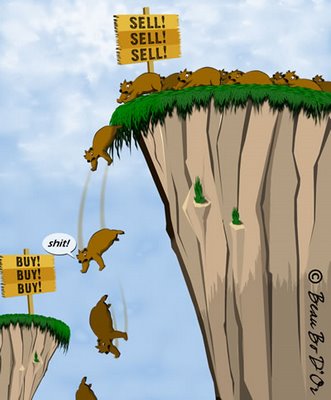
This more or less explains the mass hysteria that has taken place the last couple of weeks in global markets. Many people I know take great pleasure in telling me, “See, you’re always talking about how good an investment the stock market is, doesn’t look so great now huh!” Of course my response of, “Actually it does look great right now, it may look amongst the best I’ll see in my young adult life, I’m really happy about it,” only serves to make them think I’m actually more crazy than they initially believed. You see, people that don’t understand the fundamental basics of stock valuation, or return on investment, only get the 20 second sound bites from their sensationalistic evening news and then they believe that the sky is falling. Ladies and gentleman, look around you, this is not the great depression, the sky is still up there, we will wake up tomorrow, and people will continue to buy US Treasuries. For myself as a young investor, talking purely from a selfish standpoint, this market is absolutely great. The longer stocks stay “cheap” the better long-term position I can get for myself in the market. Look at the people that bought stocks near the bottom in 2008, they are still laughing. I expect to hold onto the vast majority of my investment positions for decades, so I just want to get into the market as cheaply as possible and then sit there and watch my returns grow and compound. It has been well documented that it is almost impossible for people (even “experts”) to predict the exact peaks and valleys of the stock market, but I do know this. If you follow the simple rule of investing when news anchors are screaming, “This time is different, we’re all doomed,” and backing off a little when everyone starts thinking they are the next Warren Buffett because the market has been rising for several years, you will do absolutely fine.
The Stock Market Doesn’t Lie… But Agencies Do
I love how much news space the ridiculous downgrading of US debt got over the weekend. For those of you that aren’t familiar with the investment grading system, there are three main agencies (Fitch, Moody’s, and Standard and Poor’s) that kind of rank investment options according to how stable they are, and the probability that they will be able to meet their financial obligations. Obviously a few large governments are considered the most stable and so they get an AAA rating (the highest). There are some well-established companies like Microsoft and Johnson & Johnson that also have AAA ratings. I am simplifying a bit here, but for the first time in recent memory one of the ratings agencies (Standard and Poor’s) downgraded USA Bonds/Treasuries from AAA, to AA+. This means that the agency thought there was actually some chance that the USA might default on it’s debt through not paying out bond holders. This is absolutely ridiculous, and the free market proved it on Monday. If the ratings change was right, less people would want US bonds and consequently the government would have had to offer higher interest rates to entice more people to buy US bonds. Instead the opposite happened, and more people than ever increased the demand for US bonds, driving interest rates even lower than before. This proves that people believe US Treasuries are still among the absolute safest bets in the world. The truth is that almost certainly Standard and Poor’s were doing someone a favour, making a political statement, or just simply wanted free publicity (which it got in spades), because there are really no economic indicators to justify the downgrade. My boy Warren Buffett (whose word I take long before that of ratings agencies) even issued a statement saying that he believes that US Treasuries should have their own rating of AAAA because they are actually that stable relative to anything else on the market. As usual, the markets showed that Buffett is much smarter than pretty much anyone else in the business world.
Money Is Just a Tool, Not Emotional Magic
All this negative publicity and subsequent overreaction by investors, has led me to think about a few things. The first one is just how driven by emotion most investors are. People have to remember that money is just a tool, and that it should be used logically just like anything else. Listening to the hype and buying gold right now as you sell off your stocks will almost assuredly lead to huge losses (in fact I think there is some serious money to made in shorting gold about 2 years from now). Forget the cliché of “buy low, sell high” because it’s impossible for most of us to know where “low” and “high” actually are. Instead, just remember to buy when everyone is screaming not to because the markets are in terrible shape and the outlook is even worse, and sell when everyone is talking about why the stock market will rise forever and how there will never be another recession. This is much easier to measure (this is another idea stolen from Buffett and put into laymen’s terms).
Good Memories…
My only questions are what sort of long term cycle do you think we are in? Is this going to be a relatively quick turnaround that sees us get back to 2007 levels and beyond? Or are we headed for a decade of sideways movement as people and governments continue to pay off their debt loads and de-leverage? All I know for sure is that now is the time to be investing in equities and that when I’m 40 and everyone is talking how much money their stock market portfolio made last year, I’ll just nod and smile and tell them that I miss the good ‘ole investing days of 2008 and 2011!