

I recently came across this video when talking to a friend of mine, and instantly became a huge fan of it (maybe even a prophet for it?). The message is definitely brilliant, but the medium in which it is delivered is equally outstanding (as a University of Manitoba alum, I should probably toss in fellow Bison Marshall McLuhan’s famous quote that, “The medium is the message”). The narration is actually a “Ted Talks” speech by Sir Ken Robinson. If you’re not familiar with what Ted Talks is, the basic idea is that someone has decided to get together some of the world’s greatest authorities on an incredible range of topics, and just give them a public forum to explain their findings to the world. It’s definitely worth checking out if you have a few minutes to kill. This very informative speech, has been translated into creative symbols and pictures on a whiteboard by an animation specialist. The overall effect really hits on several different modes of communication, and is broadly applicable to many different types of learners.
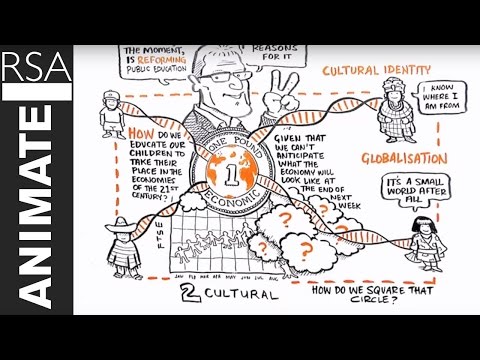
“That Classroom Is SOOO Last Century”
The main idea of the article is that we have to change our paradigms in education because they are simply not fit for the realities of the 21st century. Robinson specifically focuses on the fact that we the old story of, “Pay attention in school, then go to college, and you will be guaranteed a good job,” just doesn’t work anymore. He goes on to to point the complete idiocy of setting all schools up as mini-factories. Finally, he shows how our current methods of 1800-inspired education is astonishingly effective at quashing our natural ability to think creatively. I won’t go into any more detail because you should just watch the video!
The More Things Change… The More Schools Stay The Same
The idea if educational reform has been around as long as education itself, but it is interesting to think about how little our schools have actually changed, and how resistant academics and teachers are to any change at all. I heard an anecdote a few years ago, and unfortunately I can’t remember the source, but it went something like this:
If someone were teleported from 1900 into the present day they would be absolutely terrified of everything around them. Cars would honk their horns as they tried to cross the street, people would laugh at them for “snail-mailing” information, and the idea of being on the other side in the world in half of a day would be as ludicrous as that of time travel itself. However, when this person walked into a school, they would likely say something like, “Finally, I’m home.”
Think about the truth behind that for a second. In 1900 there was no such thing as an oil change, the telegraph was still a big deal, and airplanes were a distant dream; however, a school day started at around 8:45, ended around 4:00, had a bell that rang to signal a change in the periods. Schools were organized according to specific subjects, and connections between the subjects, as well as connections to the outside world, were not really emphasized. Teachers were lower-professionals whom no one would describe as “elite-thinkers,” and information was often delivered in a lecture-style, or in written form. People who did not take naturally to this style of learning were usually thought of as substantially less intelligent than those that did. Does that sound familiar to anyone? It really is absolutely incredible that with all the technology and psychological advances we’ve made in the last century, our current methods for educating people today are much more similar than different from those of yesteryear.
Our Greatest Minds Hated School – What Message Does That Send?
Robinson makes some very good points that can be broadly applied to the entire education system. I find it notable that the greatest American entrepreneurs of the last decade all felt much too confined by traditional educational methods. Steve Jobs, Bill Gates, and Mark Zuckerberg are just a few examples of creative genius that felt their needs were not being met by a system primarily designed around the time Canada became a country! With China, India and many other developing countries growing increasingly proficient at pumping out huge numbers of extremely capable linear thinkers in professions like medicine, it is fairly well established that in order to keep a competitive advantage, Western countries will need to be more creative and innovative than the rest of the world. We need to seriously ask ourselves if our current approach to education is in line with the economic reality we are throwing our young adults into.
The Next Step
The one key criticism I have of Sir Ken and some of the other very intelligent educational reformers out there, is that they are very good in point out the flaws in the system (the significance of which should not be understated), but they definitely lack many practical suggestions for how to improve things. The standard lazy/set in their ways teacher watches something like this and usually quickly dismisses it by saying something like, “They can’t cut it in the classroom, and they don’t present any solutions so it’s a waste of time.” Teachers often become practical to an extreme since their day often involves their nose being shoved into reality several times every period.
Here are a few random ideas I had when considering Robinson’s work:
1) We absolutely need to start “streaming” students in a more efficient manner. Sir Ken is right when he says organizing children by “date of manufacture” makes no sense. We need to stuff all the edu-babble about “equal opportunity” and “differentiated learning in the same classroom” and start facing reality – different students want different careers, need different things out of the school system, and learn in vastly different ways; therefore, stuffing them all in the same classroom is actually quite harmful, and borders on idiotic.
2) The streaming of students should naturally lead to separate schools of excellence for top performers in multiple areas. We need to create bastions of higher-learning to keep gifted students striving long before they hit the age of 18. Right now private schools fill this need to some degree, but this is marginalizing a huge portion of the population that is obviously producing some potentially brilliant thinkers. Not everyone needs to go to these schools, and parents need to realize that there is nothing wrong with going to a vocational school and making 30% more than a school teacher by taking up a trade.
3) Raising standards is not a luxury-based recommendation any longer. China, India, and many other countries have decided that for us. We absolutely need to heighten standards and this will no doubt raise failure rates (although these losses should be mitigated by some of the other proposals), but this is a fair price that we need to quit running away from. Watered-down curriculums have terrible long-term effects.
4) The edu-babble and endless loop of the same recycled education ideas has to stop. We need to experiment, bring in ideas from the business world, steal from Germany, China, Finland, and Singapore, innovate and think outside the box. Right now everyone at the top of the food chain was educated in an era when computers were something used by NASA. We need to have acceptance of what Sir Ken is talking about at the grassroots level, so that we develop the political will to make meaningful changes to the system, and not present the same old stuff dressed up differently.
5) Teachers unions need to shut up. Our pay should simply be indexed to inflation. Benefits should be debated once and then left alone. Unions could then be replaced by actual organizations that had the students’ best interests in mind (and those of society by extension) instead of by the teachers who don’t want to be in the classroom (it’s a dirty secret that teachers’ unions are run by former teachers who couldn’t cut it). These unions might be the single biggest obstacle potential reform currently faces… and that’s really saying something.
6) We need to recognize that the best quartile of teachers out there, make a huge difference relative to average, or the large number of “below average” teachers out there. Today’s technology makes it possible for a lot of the lectures and lesson plans to be delivered by these elite teachers, and merely facilitated by classroom teachers. Let’s stop pretending every teacher is the same, pay a bonus to the top quartile, and have them design online courses that students can engage with through technology. I bet Apple, Gates, and Zuckerberg would even fit a huge part of the bill for this if we asked them nicely!
7) Show me the money baby! Robinson is right when he says schools are structured along factory lines. There is a reason factory lines come so highly recommended – they’re efficient and cheap! If we deviate from this process I guarantee it will cost more taxpayer dollars. There are many arguments out there that the eventual cost to society of kids being disengaged from the education system is far greater than meaningful reforms out there, but the immediate political reality is that people have to understand that investing in education costs real money. However, if we’re going to ask people for this money, lets have a viable plan in place that we can show people in exchange for their hard-earned dollars.
There are a few other proposals I can think of, but at this point your eyes are likely glazed over (if only I had an animation of all this…), so I’ll leave the ball in your court. At some point I hope to be in a position to affect some amount of change. The first step is being open to new ideas… so let me hear some!